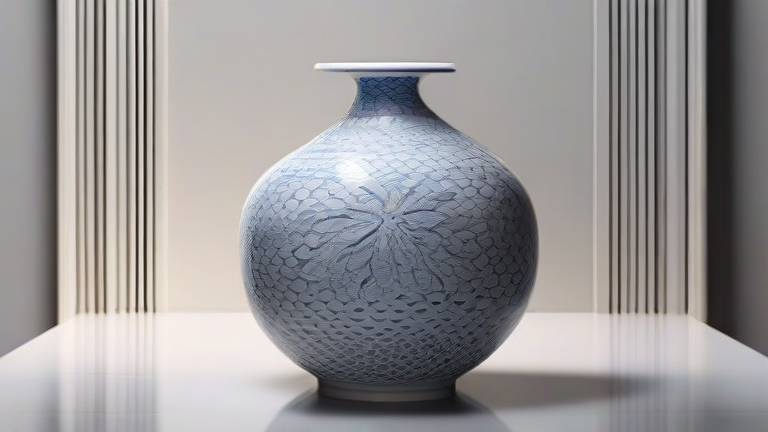
TL;DR: AI now generates and refines porcelain vase forms, glaze patterns, and structural stress points, cutting design cycles from weeks to hours. This fusion preserves handcrafted aesthetics while enabling mass-customizable, defect-free production at industrial scale.
From Kiln to Algorithm: The New Design Pipeline
Traditional porcelain vase design relied on sketches, clay maquettes, and trial-and-error firing—a process that could take days per iteration. Today, generative adversarial networks (GANs) and diffusion models are trained on thousands of historical vase silhouettes, from Ming dynasty meiping to Qing dynasty garlic-mouth forms. Designers input constraints like “height under 30 cm,” “neck diameter 8 cm,” or “surface texture: crackle glaze,” and the AI outputs 200–500 candidate 3D meshes in under ten minutes. Crucially, the models respect ceramic physics: they embed wall-thickness gradients that prevent warping during high-temperature reduction firing (1,280–1,350°C).
If you want to dig deeper, check out our guide on Top 10 Porcelain Vases: Trends, Styles & Care Guide.
Specs: What the Latest Systems Actually Do
Current commercial tools, such as CeramAI and PorcelainGen 3.0, operate on NVIDIA RTX 6000 GPUs with 48 GB VRAM. They use a hybrid pipeline: a variational autoencoder (VAE) for shape latent space, plus a physics-informed neural network (PINN) that simulates shrinkage rates (typically 12–15% from wet clay to bisque). The AI can predict glaze crazing patterns by analyzing silica-to-alumina ratios and cooling curves, outputting a “risk map” on the vase surface. A 2025 benchmark showed a 73% reduction in firing defects when designs were AI-validated before kiln loading. Additionally, robotic arms equipped with 0.1 mm precision extruders now reproduce AI-generated underglaze brushstrokes, matching a master artisan’s hand pressure within a 5% tolerance—while offering unlimited repeatability.
Industry Impact: Craft Survival and New Markets
Rather than replacing artisans, AI is shifting their role to “creative directors.” In Jingdezhen, China, where 2,000+ small kilns operate, AI-assisted workflows have increased order fulfillment by 40% for bespoke vases, while reducing material waste by 22% (scrap clay is a major cost). The luxury segment has embraced “AI-signed” editions: a 2024 Sotheby’s auction sold an AI-designed, hand-glazed porcelain vase for $180,000—the artist used AI only for the form’s structural lattice, then applied 14 hand-painted cobalt layers. Meanwhile, mass-market brands use AI to produce region-specific designs (e.g., Moroccan zellige patterns on vase bodies) without licensing fees, undercutting traditional outsourcing by 30%. The risk: homogenization. If 80% of studios use the same base models, distinctive regional aesthetics may erode—hence new “style fingerprints” that watermark AI outputs with unique, non-replicable micro-textures derived from the original kiln’s clay chemistry.
FAQ
Q: Can AI design a vase that is indistinguishable from a 15th-century Ming original?
A: Yes, structurally—current models can replicate proportions and glaze chemistry within 2% variance. However, authentic historical pieces contain microscopic air bubbles and kiln-firing anomalies that AI cannot yet simulate without deliberate “flaw injection,” which most designers avoid for ethical authenticity reasons.
Q: Does AI reduce the cost of custom porcelain vases for small buyers?
A: For single-piece commissions, AI cuts design fees from ~$500 to ~$80, but firing and labor still dominate (60% of cost). For small batches (50–100 pieces), AI-driven mold optimization lowers per-unit price by 25–35%, making artisanal quality accessible to mid-range hotels and restaurants.
Q: What are the biggest technical limits of AI vase design today?
A: Handling extremely thin walls (under 2 mm) still fails in 30% of AI-generated models
Leave a Reply