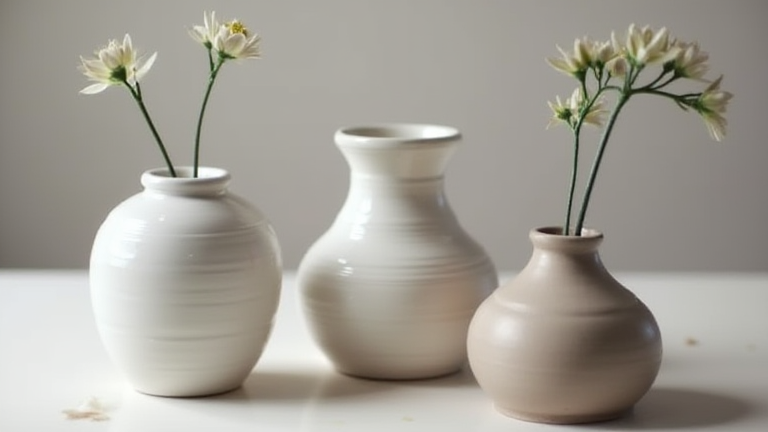
TL;DR: To make a porcelain vase, you shape prepared porcelain clay on a wheel or by hand, let it dry to leather-hard, then trim and refine the form. After a bisque firing, you apply glaze and fire it again at high temperature (around 2300°F/1260°C) to vitrify the clay into translucent, non-porous porcelain.
Step 1: Prepare Your Porcelain Clay
Start with a high-quality porcelain body (e.g., kaolin-based, like Grolleg or Standard 365). Wedge the clay thoroughly to remove air pockets—porcelain is finicky and any trapped air will explode in the kiln. Keep the clay covered with plastic when not in use, as porcelain dries faster than stoneware. For a vase, you’ll need about 2–3 lbs for a 6-inch tall piece.
If you want to dig deeper, check out our guide on DIY Porcelain Vase Tutorial: Step-by-Step Guide.
Step 2: Center and Throw the Base
Place the wedged clay firmly on the wheel head. Wet your hands and center the clay at a medium speed—this is critical: if off-center, the vase will wobble. Once centered, open the clay with your thumb, leaving a ½-inch thick base. Pull the walls upward using a sponge in your left hand and fingers in your right, keeping the wall thickness even (about ¼ inch). For a vase, pull the walls straight up first, then flare the neck outward.
Step 3: Shape the Belly and Neck
After reaching about 5 inches in height, use a rib to define the belly (widest part) and then narrow the neck. Porcelain is soft, so support the interior with one hand while shaping outside. To create a classic vase silhouette, gently press inward at the neck, then flare a small lip outward. Smooth the rim with a wet sponge to avoid sharp edges.
Step 4: Trim the Foot and Dry to Leather-Hard
When the vase is firm enough to handle (leather-hard, like a hard cheese), invert it on a padded chuck. Trim the foot ring to a ¼-inch height and bevel the inner edge. Porcelain trims like butter—use a sharp loop tool. Then let it dry slowly under plastic for 24 hours, then open air for 24 hours. It must be bone-dry before firing.
Step 5: Bisque Fire and Glaze
Fire the vase to cone 04 (1940°F/1060°C) for bisque. After cooling, inspect for cracks. Apply glaze—for porcelain, use a glossy or celadon glaze to highlight translucency. Dip the vase into glaze for 3 seconds, or brush 2–3 thin coats. Leave the foot ring unglazed to prevent sticking to the kiln shelf.
Step 6: High-Fire to Vitrification
Fire the glazed vase to cone 10 (2300°F/1260°C) in a reduction atmosphere (gas kiln) or cone 6 (2232°F/1222°C) in electric. This melts the silica and feldspar, turning the clay vitreous—non-porous and slightly translucent. Cool slowly for 12 hours. The result is a durable, glass-like vase.
Pro Tips for Success
• Keep a spray bottle nearby—porcelain cracks if it dries unevenly.
• Use a bat instead of a wheel head to avoid warping when removing.
• Test your glaze on a small tile first; porcelain shrinks ~13%, so adjust firing schedule.
FAQ
Q: Why does my porcelain vase crack during drying?
A: Most likely uneven drying—porcelain has low plasticity. Cover with plastic for the first 12 hours, then slowly open the plastic over 2 days. Also, avoid thick rims (over ½ inch) that dry slower than the walls.
Q: Can I
Leave a Reply