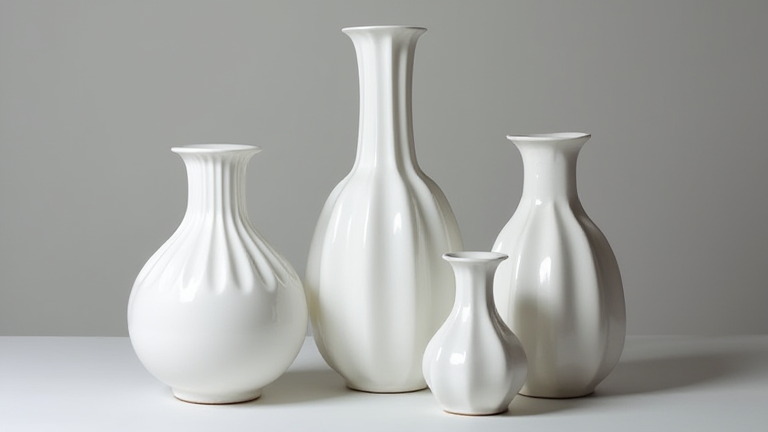
TL;DR: Advanced additive manufacturing now enables the creation of structurally complex porcelain vases with unprecedented precision and intricate geometries. This technology bridges the gap between traditional ceramic artistry and modern industrial design, offering customizable, high-fidelity products for both luxury markets and functional applications.
Revolutionizing Ceramic Form
The intersection of additive manufacturing and traditional ceramics has reached a critical milestone with the maturation of 3D printed porcelain technologies. Historically, creating complex hollow ceramic forms required sophisticated slip casting or hand-throwing techniques that limited geometric complexity and increased waste. Recent developments in high-precision Fused Deposition Modeling (FDM) and Stereolithography (SLA) for ceramic resins have dismantled these barriers. Manufacturers can now layer fine-grained porcelain slips or photopolymerized ceramic slurry to produce vases with internal lattice structures, organic curves, and micro-features that are physically impossible to achieve through conventional molding. This shift allows designers to explore negative space and structural integrity in ways that redefine aesthetic potential while maintaining the inherent translucency and strength of fired porcelain.
If you want to dig deeper, check out our guide on How to Start a Profitable Porcelain Vase Business.
Technical Specifications and Material Science
Modern 3D printed porcelain vases utilize specialized ceramic inks containing high-purity kaolin, feldspar, and quartz particles suspended in a viscous binder. The key specification for these systems is particle size distribution, typically ranging between 10 and 50 microns, which ensures smooth layer adhesion and a defect-free surface finish after sintering. Print resolution has improved to approximately 50 microns in the XY plane, allowing for crisp detailing and thin wall thicknesses of less than 1 millimeter. Post-processing is equally critical; the green bodies undergo controlled drying to prevent cracking, followed by high-temperature sintering at 1,200 to 1,400 degrees Celsius. This process reduces the material volume by 15 to 20 percent while achieving a final density comparable to hand-thrown ceramics. The resulting vases exhibit high thermal shock resistance and low water absorption, ensuring durability for both decorative and functional use. Furthermore, multi-material printing is emerging, allowing for gradient glazes or inlaid metallic accents directly during the printing phase, eliminating the need for secondary decoration processes.
Industry Impact and Market Shifts
The adoption of 3D printed porcelain is reshaping the luxury goods and home decor sectors. For artisans, this technology reduces the skill barrier for producing complex forms, enabling small-scale studios to offer bespoke, limited-edition collections without the high capital investment required for custom molds. For large manufacturers, it accelerates prototyping cycles, allowing for rapid iteration of design concepts and reduced time-to-market. The environmental impact is also positive, as additive manufacturing minimizes material waste compared to subtractive methods or failed castings. However, challenges remain in scaling production speed and managing the energy costs of sintering. As hardware costs decrease and software for ceramic simulation improves, 3D printed porcelain vases are poised to become a standard offering in high-end retail, blending the timeless appeal of ceramics with the limitless possibilities of digital fabrication. This convergence promises a future where traditional craftsmanship is augmented rather than replaced by digital precision.
FAQ
Q: Are 3D printed porcelain vases as durable as traditional ones?
A: Yes, when properly sintered, they achieve similar density and strength profiles to conventional ceramics, though surface texture may vary based on print resolution.
Q: Can these vases hold water safely?
A: Absolutely, provided a high-quality glaze is applied to seal the surface, they are watertight and suitable for holding water or flowers.
Q: What is the main advantage of 3D printing over slip casting?
A: The primary advantage is the ability to create complex, non-repetitive geometries and internal structures without the need for expensive custom molds.
Leave a Reply