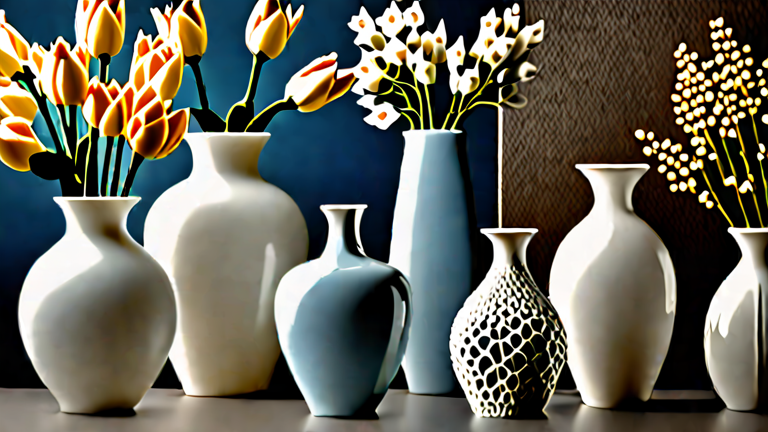
3D-Printed Porcelain Vases: The Future of Ceramic Art
TL;DR: 3D-printed porcelain vases are revolutionizing ceramic art by enabling complex geometries and precise customization that traditional methods cannot achieve. This technology is rapidly transitioning from a niche experimental tool to a viable commercial production method, significantly impacting the high-end home decor and artistic markets.
The landscape of ceramic manufacturing is undergoing a silent but profound transformation. For centuries, the creation of porcelain vases relied on the skilled hands of artisans using wheel-throwing, slip casting, and hand-molding techniques. These methods, while beautiful, impose strict limitations on shape complexity, consistency, and production speed. The advent of additive manufacturing, specifically tailored for high-alumina and high-mica porcelain materials, has shattered these constraints. Modern 3D printing systems now utilize photopolymerization or binder jetting processes to create vases with intricate lattice structures, organic curves, and internal cavities that were previously impossible to fabricate. This shift allows designers to explore form and function in ways that defy traditional physics and artistic norms.
If you want to dig deeper, check out our guide on Elevate Your Home: 10 Chic Porcelain Vase Styling Ideas.
Technical Specifications and Material Innovation
The core of this revolution lies in material science. Standard 3D printing resins are unsuitable for high-temperature ceramic firing. Therefore, the industry has developed proprietary ceramic slurries and photopolymerizable binders. These materials contain fine porcelain particles, typically ranging from 20 to 50 microns, suspended in a viscous medium. The printing process involves layer-by-layer deposition, with layer thicknesses as fine as 50 microns, ensuring exceptional surface detail. After printing, the vase undergoes a debinding process, where the organic binder is carefully removed through heat and chemical treatment without cracking the fragile ceramic structure. The final stage involves high-temperature sintering at 1,400 to 1,450 degrees Celsius. During this phase, the porcelain particles fuse together, resulting in a dense, non-porous, and highly durable object. The resulting vases exhibit a translucency and luster comparable to, or even exceeding, that of traditionally kiln-fired porcelain. Furthermore, the dimensional accuracy of 3D-printed vases is within 0.1 percent, ensuring that paired vases or series items are perfectly identical, a feat nearly impossible in manual craftsmanship.
Industry Impact and Economic Shifts
The economic implications for the ceramic industry are substantial. Traditional porcelain vase production is labor-intensive and time-consuming, with lead times often stretching weeks or months. 3D printing reduces the design-to-prototype phase from days to hours, allowing for rapid iteration and market testing. This agility is particularly beneficial for limited-edition artistic collections and custom furniture pieces. Manufacturers can now offer mass customization, where consumers can upload their own designs or modify existing templates to create unique vases. This shifts the business model from mass production of identical items to personalized, high-margin products. Additionally, the reduction in waste is a significant environmental benefit. Traditional ceramic processes often involve significant material loss during trimming and glazing. Additive manufacturing uses only the material necessary for the final object, minimizing waste and reducing the carbon footprint associated with material extraction and disposal. While the initial cost of 3D printing equipment and specialized materials is high, the long-term savings in labor and waste offset these expenses, making the technology increasingly accessible to mid-sized studios and large manufacturers alike. As the technology matures, we expect to see a broader integration of 3D-printed porcelain vases into mainstream interior design, bridging the gap between digital artistry and physical craft.
FAQ
Q: Are 3D-printed porcelain vases as durable as traditional ones?
A: Yes, when properly sintered at high temperatures, 3D-printed porcelain vases achieve similar density and strength to traditionally fired porcelain, making them durable for long-term use.
Q: What is the primary advantage of 3D printing over wheel-throwing for vases?
A: The primary advantage is the ability to create complex, non-revolving geometric shapes and intricate internal structures that are physically
Leave a Reply