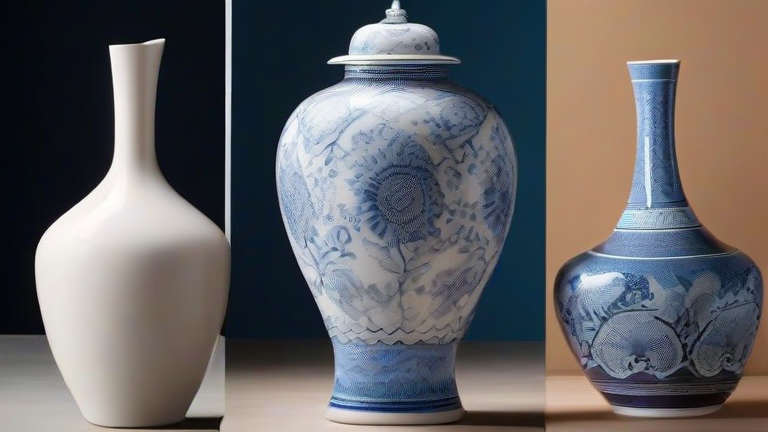
**The Tech Behind Porcelain Vases: Smart Kilns & Digital Artistry**
TL;DR: Modern porcelain vase production relies on IoT-enabled smart kilns that monitor temperature and atmosphere with millimeter precision, eliminating traditional firing defects. Simultaneously, digital design tools allow artisans to create complex geometries and textures that are impossible to achieve through manual sculpting alone.
The Revolution in Firing Technology
For centuries, the firing of porcelain was a dark art, reliant on the intuition of the potter and the consistency of the flame. Today, that uncertainty has been replaced by data-driven precision. The latest developments in smart kilns utilize arrays of thermocouples and atmospheric sensors that feed real-time data to cloud-based processing units. These systems do not merely heat the clay; they manage the entire thermal profile of the firing cycle. By maintaining specific oxidation or reduction states to within a fraction of a degree, manufacturers can ensure that the vitrification process occurs uniformly across the entire vessel. This is critical for high-end porcelain vases, where even a minor temperature fluctuation can cause warping, crazing, or inconsistent glaze melting. The integration of machine learning algorithms allows these kilns to predict potential issues before they occur, adjusting gas flow or electric element power dynamically to correct deviations in real time.
If you want to dig deeper, check out our guide on Porcelain Vases for Modern Living: Elevate Your Home Decor.
Digital Artistry and Design Specifications
While the kiln handles the physical transformation, digital tools have revolutionized the aesthetic creation of porcelain vases. Artists now employ 3D modeling software to design intricate forms that defy traditional wheel-throwing limitations. These digital files are often used in conjunction with rapid prototyping to test structural integrity before committing to expensive porcelain clay. Furthermore, digital printing technology allows for the application of ultra-fine detail onto the vase surface. Unlike traditional brushwork, digital decal transfers can achieve resolutions of over 1,200 DPI, enabling the placement of microscopic patterns, gradients, and photorealistic imagery onto the porcelain body. The specifications for these digital assets are becoming increasingly complex, supporting multi-layered glaze effects that simulate depth and texture. This convergence of digital precision and material science means that a single vase can feature a body with a thickness variance of less than 0.1 millimeters, a standard that was previously unattainable in mass production.
Industry Impact and Market Shifts
The adoption of these technologies is reshaping the ceramic industry in profound ways. For manufacturers, smart kilns have drastically reduced waste rates, with some factories reporting a 40% decrease in defective products. This efficiency allows for smaller batch production of high-value items, catering to the luxury market where uniqueness and perfection are paramount. For consumers, the result is a product that combines the timeless appeal of porcelain with modern engineering reliability. The ability to replicate complex digital designs ensures consistency across limited editions, making them more accessible to collectors. Moreover, the data generated by smart kilns is being used to develop new glaze formulations, accelerating the R&D cycle. As sensors become cheaper and more accurate, we expect to see further integration with augmented reality, allowing buyers to visualize how a specific digital design will look on a physical vase before it is even fired. This technological synergy ensures that porcelain vases are no longer just decorative objects, but sophisticated intersections of art, science, and engineering.
FAQ
Q: Do smart kilns require constant human supervision during the firing process?
A: No, modern smart kilns operate on autonomous protocols. While artisans set the initial parameters, the system monitors and adjusts conditions automatically, only alerting the user if a critical anomaly is detected that requires manual intervention.
Q: Can digital designs be applied to traditional hand-thrown porcelain vases?
A: Yes, digital printing and decal technology can be applied to both hand-thrown and machine-molded vases. The digital layer is applied after the initial forming and before the final glazing, ensuring compatibility with traditional production methods.
Q: How does the use of digital tools affect the cost of a porcelain vase?
A: While the initial investment in smart kilns and digital equipment is
Leave a Reply